
Insight: What makes great hospitality branding?
An introductory guide to hospitality brand strategy, visual identity and customer experience.
1st June 2026
Introduction
Great hospitality branding is often misunderstood. Many people assume branding starts with a logo, colour palette or interior design scheme. In reality, the strongest brands are built from the inside out, beginning with a clear positioning and extending into every customer interaction. Whether we're talking about a neighbourhood café, a fine dining restaurant or a growing hospitality group, effective branding is about creating a consistent experience that customers understand, remember and want to return to.

Start with strategy
It sounds obvious, but the starting point of any hospitality branding project should always be to understand what the concept is and who it’s for. For many founders of new concepts, this is almost instinctive, and that’s fine, but as a result they sometimes don’t take the time to document, challenge and refine the positioning or in some cases clearly articulate it to partners and stakeholders. On more than one occasion we have started a brand positioning workshop with clients only to discover that members of the client team have varying understandings of the concept offer or what the customer experience should be. That’s not a problem if it is identified early in the project cycle and a solid positioning is agreed, but without it, a project is like a rudderless ship drifting without direction and hoping to find land.
Connect with customers emotionally
Whether you are serving sandwiches, or offering a Michelin-quality tasting menu, hospitality is an emotive thing which can spark joy in customers, lift them out of funk, or simply be the precious time they get to themselves at lunchtime during a busy workday. In short, it should always be an experience as opposed to just fuel (although the latter could be the starting point for your positioning if you have identified a need for it!).
In any context, great branding comes to life when we take the insights and decisions from our positioning and look at opportunities to create memorable ‘micro-experiences’ for our customers. These don’t need to be groundbreaking, just considered. For example, if we are a dog friendly café, can we make our furry friends feel at home by placing dog beds in out-of-the-way locations as was done at Chasing Rabbits café in Hove.
Another example is a steak restaurant whose target customer is city workers. Some customers were wanting quick turnarounds to fit a lunch into an hour, whereas others were lucky enough to be entertaining clients on expense accounts and were looking for an altogether more drawn-out affair. We saw this as an opportunity to differentiate from the competition by simply asking customers on arrival how much time they have for their meal, so the service and approach could be tailored accordingly. It’s simple to the point of being obvious, but how many restaurants show that they understand their customers’ needs and meet them by asking this simple question?
These interactions are all part of the brand and contribute directly to the overall hospitality customer experience. When customers feel understood, they are far more likely to remember us, recommend us and return.

Creating a distinctive visual identity
Once we have a clear positioning defined, we can begin to create a visual identity built on that foundation. This includes the name (although not technically visual, it sits in this stage) logo, colour palette, typefaces, and sometimes visual devices like patterns and motifs etc. All these items are cues that send messages to our customers about the offer which, in turn, helps them to decide if we are the right choice for them. We need to make sure that we send the right messages. Again, it sounds so obvious, but it’s very easy to get caught up in what we ‘like’ when creating visual identities versus what the hospitality customer wants or needs. Our approach is always to ‘audit’ the visual identity against the positioning and look for opportunities to build on this. For example, if our positioning says our brand personality is playful but not childish, is that represented in our visual identity?
A great example of this is our work with Amber at Bayon Bakery. Like many successful cafe branding projects, the challenge wasn't simply creating something attractive but creating something that felt authentic to the experience and values behind the business.
Amber already had a clear idea of the feel she wanted, and we were able to expand on this by introducing a brand essence of ‘simple pleasures’. This led to a series of line illustrations showing these everyday simple pleasures, like a child in wellies jumping in a puddle on a rainy day or walking the dog.
Along with the choice of logo, colours and typeface, these illustrations bring a feeling a warmth and playfulness without drifting into the territory of childish cartoons. And importantly, you immediately get a feel for the type of experience on offer and whether you connect with it enough to ‘join the club’ of simple pleasures by becoming a customer.

Brand Applications:
Digital Brand Application
This is where we get to apply our work so far to all the different touch points along the customer journey. Understanding hospitality branding is acknowledging that it is the heart of every stage of your business, not just the logo or signage. Our Instagram or website are often the first interaction with our customers. So, do these have a written tone of voice and photography that are consistent with our brand so that our customer gets a true sense of the experience we are offering? If not, disappointment may follow! Also in the digital space, we should consider whether we have chosen an appropriate booking platform and branded it properly.
Hospitality Signage
Signage is the next touchpoint for customers as they arrive at the venue. Whether we're working on a coffee shop, hotel or restaurant brand design, signage plays an important role in setting expectations before a customer even enters the venue. We should have already considered signage when we were in the brand identity stage, but we may not have had the details of the building, food truck or wherever our venue is at that earlier stage, so this a great opportunity to enhance the customer experience and make sure the visual cues are right for our brand. Items like bespoke menu boxes and wayfinding/toilet signs which we designed at Furna restaurant can demonstrate care and attention to detail that resonates with customers.
Your staff are your brand
Once through the door (if there is one!), the customer will likely have their first interaction with a member of staff, and this is an often-missed branding opportunity. We don’t want to underplay the recruitment challenges that exists in hospitality, particularly in the UK, but put bluntly, your staff are your brand. So, they need to be the right people with the right training to represent it properly. Without wanting to harp on about positioning, it’s important that everyone in your business at every level can articulate who you are and what you stand for as a brand. So, ask them to give it a go. If they can’t or have a widely different view, then you’ve likely missed a trick somewhere along the way, and that needs addressing.
We have worked with front of house consultants who are expert at refining your customer experience through staff training, as well as other dark arts like maximising your GP through sales data analysis and menu optimisation. This may not be a cheap exercise, but it is almost always a highly valuable one.
Hospitality Menu Design
Menu design is one of the most overlooked elements of restaurant branding. While it serves a practical purpose, it is also a powerful communication tool that reinforces the brand and influences customer behaviour.
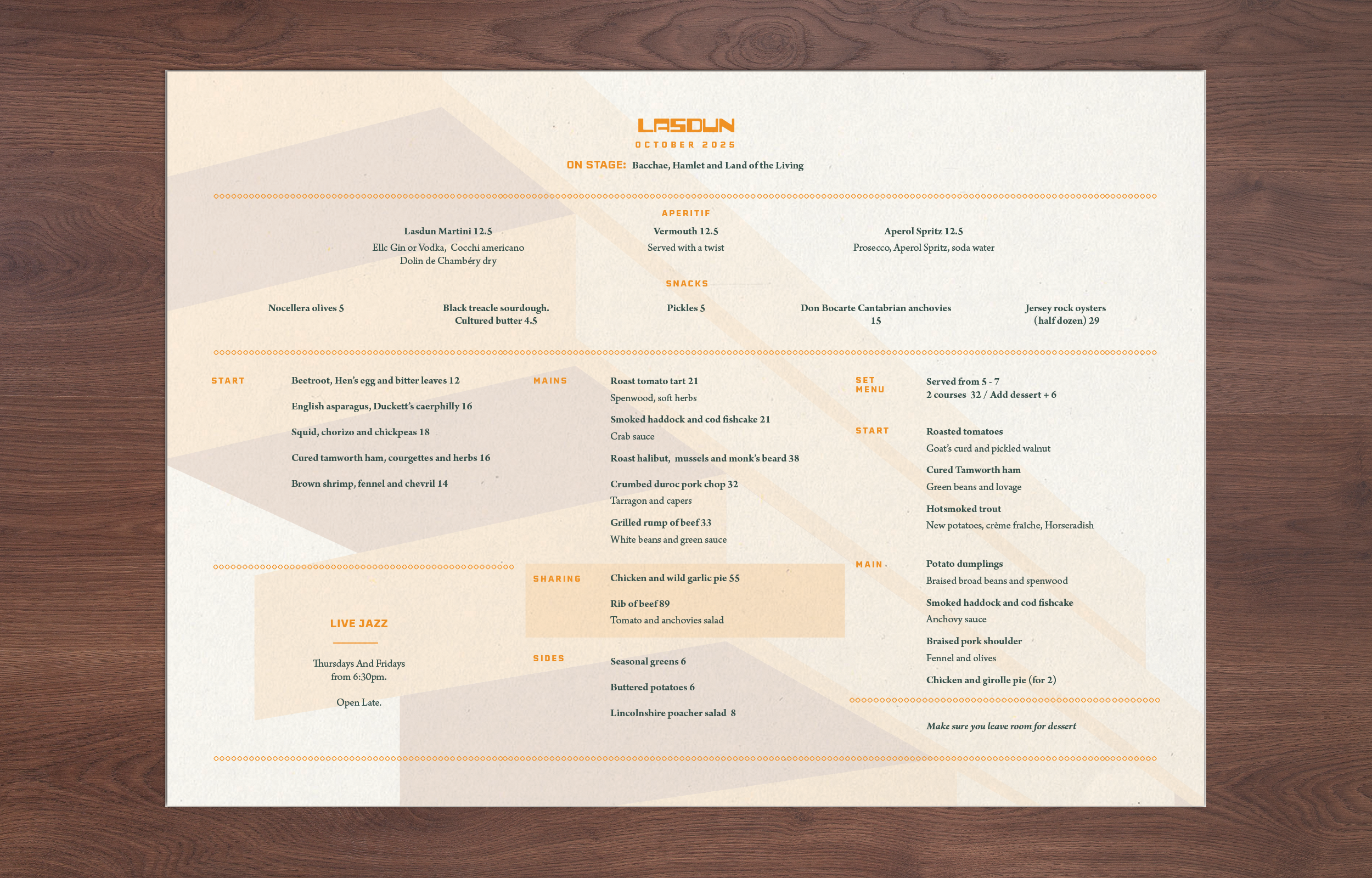
As with the signage, we have usually started to think about menu design at the visual identity stage, but it is at this point we need to dig a bit deeper into the day-to-day workings of the concept and consider the practicalities that inform our design. For example, we do not want to create a complex menu layout if the contents are going to be updated daily by the in-house team, as this will also lead to a messy menu. Sometimes simplicity is best. St. John in London are a great example of this: Simple, centre-aligned serif text on an A4 paper which is updated and printed daily. It matches perfectly with the intentional utilitarian nature of the brand, where the food is the star.
In other cases, the regular menu items are updated less frequently, in which case a more thoughtful and complex design can be created, sometimes using customer psychology insights to position and present key items to drive GP by encouraging the selection of certain items through our layout. Our work with Indian Summer Restaurant is a good example of this. View our case study here.
As with all things branding, whether we are designing a wall mounted menu for a coffee shop, a twenty page cocktail and drinks menu for a fine dining restaurant, or selecting the right paper stock for in-house printing of a specials menu, the key is to make sure that it is considered, intentional and consistent with how we should be presenting the brand as defined in our positioning.
In summary, what makes great hospitality branding?
The devil is in the detail
These are only a few of the touchpoints that are part of the branding landscape. There are myriad other items and ideas that can be put to work to build a connection with our customers, create memories and encourage loyalty and repeat visits. And, if we get it just right, develop the powerful marketing tool that is customer evangelism: People that can’t wait to tell their friends about their latest ‘must visit destination’, the best burger place, the nicest coffee van, the most delicious sandwich shop or the to-die-for dessert place. These experiences are almost always built on more than the food, it’s the whole experience, although the customer may not always notice this. It’s the integration with the interior design, the sound in the space, the coffee cups or takeaway containers, the uniforms, the loyalty cards or even the smell… it’s all part of the cumulative brand experience that makes a place special.
The key to great branding in hospitality is building a strong foundation with our positioning, then using this to inform ALL other decisions. It’s about being considered and consistent in our approach. This doesn’t mean it needs to be stiff or rigid: You may decide that your approach is to build a collage of styles where nothing matches. Whilst this may present a few practical challenges, if that’s the approach that you have agreed on in your positioning, then go for it, and execute it ruthlessly. Mismatch to your heart’s content. Just be considered and consistent with it.
There are many different definitions of branding, but a certain Jeff Bezos was quoted as saying “Branding is what other people say about you when you’re not in the room, but effective branding means there are no other people.”
We would be inclined to change that second ‘branding’ to ‘positioning’, but you get the picture: Branding is incredibly powerful when it’s done right, and branding in hospitality is no different.